How to design a fair coding assessment: a checklist
Fair assessments are also better predictors. Use this 12-point rubric before you send your next coding test to ensure unbiased, job-relevant screening.
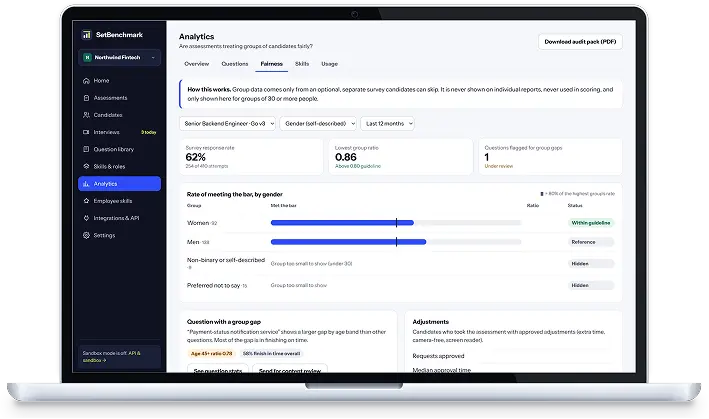
A fair assessment measures the skills the job needs, gives every candidate the same chance and treats people with respect. Use this 12-point rubric before sending your next test.
Items 01–03: Role mapping, repository tasks & realistic time limits.
Items 04–06: Transparent guidance, language choices & accommodations.
Items 07–10: Explicit AI rules, blind rubrics & human review.
Items 11–12: Adverse impact auditing & constructive candidate feedback.
| # | Stage | Checklist Standard & Rule | Why It Matters (Hiring Impact) | Status |
|---|---|---|---|---|
01 | Task Design | Role Profile Alignment Every task maps to a skill in the role profile. Remove anything that doesn't. | Eliminates Noise: Prevents trick questions, brainteasers, and puzzles that bear no relation to daily work. | Verified |
02 | Task Design | Real-World Task Fidelity Tasks look like the real job: a small repository, a real API, real data. | Job Predictive: Evaluates actual software engineering ability—debugging, APIs, and architecture—rather than memorization. | Verified |
03 | Task Design | Realistic Time Budget The total time is under 90 minutes for most roles, and time limits are realistic. | Respects Candidate Time: Keeps completion rates high (80%+) and prevents candidate fatigue from skewing results. | Verified |
04 | Candidate UX | Clear Instructions & Practice Instructions are clear, with an example and a practice question. | Equal Starting Line: Tests technical competency rather than ability to decipher confusing problem prompts. | Verified |
05 | Candidate UX | Programming Language Flexibility Candidates can use the programming language they know, unless the role needs a specific one. | Removes Syntax Barriers: Allows strong engineers to demonstrate logic, algorithms, and architecture in their best language. | Verified |
06 | AI Policy | Transparent AI Policy The AI policy for each task is stated clearly: not allowed, allowed or required. | No Guesswork: Clarifies boundaries upfront so candidates know exactly when AI assistants or agents are encouraged or restricted. | Verified |
07 | Scoring & Rubric | Objective Scoring & Rubrics Scoring uses hidden tests plus a written rubric for anything open-ended. | Standardized Marking: Every candidate is measured against identical criteria, eliminating subjective reviewer preferences. | Verified |
08 | Scoring & Rubric | Blind Review of Submissions Reviewers can't see names or photos while grading open answers, where possible. | Bias Prevention: Protects against unconscious demographic, institutional, and pedigree bias during evaluation. | Verified |
09 | Accommodations | Accessible Accommodations Adjustments like extra time, text mode or camera-free options are easy to request. | Inclusion by Design: Ensures candidates with disabilities, neurodiversity, or hardware limits have equal access. | Verified |
10 | Integrity | Human Review for Integrity Signals Integrity signals go to a person for review; nothing is rejected automatically. | Zero False Bans: Network drops, dual monitors, or permitted docs lookups are verified with evidence by a human reviewer. | Verified |
11 | Fairness Audit | Group Pass Rate Monitoring You monitor pass rates by group (from optional, anonymous data) and investigate gaps. | Adverse Impact Prevention: Proactively surfaces unintended bias in specific questions before they harm talent pools. | Verified |
12 | Fairness Audit | Candidate Closure & Feedback Candidates get a clear outcome and, ideally, some feedback. | Candidate Trust: Builds a positive employer brand and provides candidates closure and learning value. | Verified |
Why fairness and accuracy go together
Tasks that don't relate to the job add noise. Noise hurts strong candidates who are unlucky on the day and lets weaker ones through. Removing it makes the test both fairer and more predictive.
High-Noise Screening (Avoid)
Unrealistic trick puzzles, artificial speed pressure, and opaque automated disqualifications filter out senior engineering talent.
- ✕Unrelated algorithm puzzles memorized from trick catalogs
- ✕Artificial time limits testing typing speed over system architecture
- ✕Secret AI detection heuristics that falsely flag honest candidates
- ✕Subjective manual grading across uncalibrated reviewers
High-Signal Engineering Benchmarks
Practical repository tasks, realistic coding assistant policies, and double-blind human scorecards deliver predictive, defensible hiring signal.
- ✓Practical repository tasks, real production APIs, and system design
- ✓Clear per-task AI policies (allowed, not allowed, or required agentic)
- ✓Double-blind grading rubrics with recorded candidate playback
- ✓Automatic adverse impact tracking and demographic group fairness audits